Cars per employee
LinkedIn post: The productivity math nobody expects. July 2026.
Claim
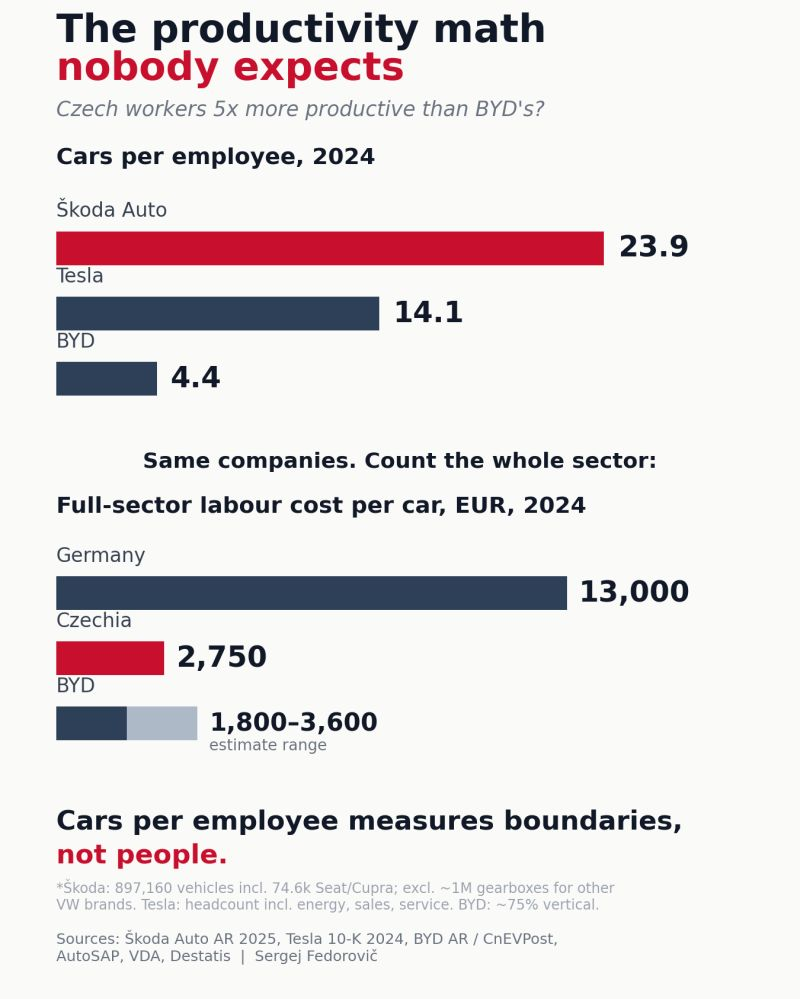
Škoda builds 24 cars per employee. Tesla builds 14. BYD builds 4. So Czech workers are 5x more productive than BYD's? No. And the way this number lies tells you more about the car industry than the number itself.
I pulled the 2024 figures from primary sources (Škoda annual report, Tesla 10-K, BYD annual report):
- Škoda Auto: 897,160 cars assembled in Czech plants, 37,551 employees = 23.9 cars per employee.
- Tesla: 1,773,443 cars, 125,665 employees = 14.1.
- BYD: 4.27M vehicles, 969,000 employees = 4.4.
Each ratio is broken differently. Škoda looks superhuman because suppliers and dealers sit outside its headcount. Meanwhile the same 37k people also built over a million gearboxes and half a million engines, mostly for other VW brands. Not in the ratio. Tesla looks average because its headcount includes the energy business, its own sales network, service, and Superchargers. Things other carmakers push to dealers and partners. BYD looks terrible because 75% of the car is made in-house. Batteries, chips, software, even the shipping. All those workers count; at Škoda their equivalents work for suppliers and don't.
Cars per employee doesn't measure productivity. It measures where a company draws its organizational boundary. The honest comparison is labor cost per car across the full sector, suppliers included. I published that math two weeks ago: Czechia 2,750 EUR, Germany 13,000 EUR, BYD 1,800 to 3,600 EUR.
The point: most Europe's car debate runs on numbers like "cars per worker" and "10x more robots." Most of them measure boundaries, not performance. And boundaries, it turns out, are exactly where the industry's speed problem lives. More on that next week.
Chart
Sources
- Škoda Auto, 23.9 Škoda Auto Annual Report 2025 (2024 comparatives): 897,160 cars assembled in Czech plants, 37,551 employees. Boundary note: the same headcount also built over a million gearboxes and half a million engines for other VW brands, not in the ratio. Includes 74,592 Seat and Cupra Atecas assembled in Kvasiny. PDF
- Tesla, 14.1 Tesla Form 10-K 2024: 1,773,443 cars, 125,665 employees. Headcount includes the energy business, sales network, service and Superchargers. Tesla Investor Relations
- BYD, 4.4 BYD Annual Report 2024: 4.27M vehicles, 969,000 employees. Roughly 75 percent of the car made in-house, so supplier-equivalent workers sit inside the headcount. Delivery and headcount reporting also tracked by CnEVPost. Document: BYD Annual Report 2024 via HKEX filings.
- Full-sector labour cost per car, EUR, 2024 Czechia 2,750; Germany 13,000; BYD 1,800 to 3,600 (estimate range on the chart). Sources: AutoSAP, VDA, Destatis. Method published in the preceding LinkedIn post.
Note from the comment thread: Toyota and GM were deliberately excluded because JV and keiretsu boundaries make their ratios canonically misleading.
Method
Headcount and production figures were taken from company annual disclosures for the same period. The ratio is total vehicles produced divided by total group employees. It is a blunt instrument on purpose: it does not separate divisions, and it is not a productivity ranking of workers. It measures how much organisation sits around each car. The second panel uses full-sector labour cost per car, suppliers included, from AutoSAP, VDA, Destatis and the author's prior calculation. The sector-level version of this math is in the auto labor math entry.
Outcome
Published July 2026 on LinkedIn. 92,000+ impressions, 33 followers gained, 18 saves, 40 substantive comments. No factual corrections were required. Comment objections and the responses to them are preserved in the post thread.
As of 9 Sep 2026 (LinkedIn analytics): 108,069 impressions, 144 reactions, 47 comments.
Corrections
None to date. If a number on this page is wrong, the correction will appear here, dated.